Optimism is the faith that leads to achievement; nothing can be done without hope and confidence. -Helen Keller

I recently read this article on “Optimism” that resonated with how I’m thinking about things these days. Personally, I prefer phrasing such as “perseverance” or “resilience,” compared to the author’s term of “tragic optimism,” but I understand his perspective. I have pasted it below and hope you find it to be a helpful resource. Blessings on your week ahead!

How Not to Fall Into Despair

Nov. 29, 2024

By Brad Stulberg

Mr. Stulberg is the author of “Master of Change: How to Excel When Everything Is Changing, Including You; Embracing Life’s Instability with Rugged Flexibility―a Practical Model for Resilience.” He writes about mental health and excellence.

When we find ourselves in the thick of disorder, uncertainty or loss, resilience can seem impossible, even trite, to hope for.

At the end of September, Hurricane Helene wreaked havoc on my community in western North Carolina. Businesses, homes and more than 100 lives were lost. Schools were closed for a month. There was no running water for nearly three weeks, and safe drinking water took far longer to come back. And yet, from Day 1, the community rallied. People were out with chain saws clearing roads; neighbors shared water, food and power sources; porches, backyards and storefronts turned into mini-congregations for daily gatherings and social support. Rebuilding will be a long and arduous process, but it is already underway….

In both North Carolina and on the national scene, it can feel like we are stymied in growth, in hope, in vigor. But every path of progress — both individual and collective — includes failures and downturns, even periods of hopelessness. In the immediate aftermath of disappointment and disorder, it is understandable to freeze or shut down. But eventually, we’ve got to rise up and move forward — if for no other reason than the alternative is worse.

Finding meaning and maintaining hope despite inevitable pain, loss and suffering is a crucial life skill. In 1949 the Holocaust survivor, psychiatrist and psychologist Viktor Frankl coined the term “tragic optimism” to describe this conundrum.

Tragic optimism emerged out of what Dr. Frankl observed to be the three tragedies that everyone faces (not only those of us who have seen the worst of the world, as he had). The first tragedy is pain, because we are made of flesh and bone. The second is guilt, because we have the freedom to make choices and thus feel responsible when things don’t go our way. The third is loss, because we must face the reality that everything we cherish is impermanent, including our own lives.

Tragic optimism means acknowledging, accepting and even expecting that life will contain hardship and hurt, then doing everything we can to move forward with a positive attitude anyway. It recognizes that one cannot be happy by trying to be happy all the time, or worse yet, assuming we ought to be. Rather, tragic optimism holds space for the full range of human experience and emotion, giving us permission to feel happiness and sadness, hope and fear, loss and possibility — sometimes in the same day, and even in the same hour.

Research shows that this sort of emotional flexibility is associated with resilience. For example, a study of U.S. college students after Sept. 11 found that those who could hold on to hope at the same time as loss demonstrated greater resilience and fewer depressive symptoms in the tragedy’s aftermath. This finding is not about denial or delusion. Most of the study participants experienced negative emotions such as anger, fear and sadness. It’s just that the more resilient ones were able to hold on to positive emotions, too.

Tragic optimism does not encourage actively seeking out or romanticizing suffering. Not everything has to be meaningful; sometimes things just suck. Rather, tragic optimism realizes the inevitability of suffering but also that we generally have at least some say in how we face it.

Difficult moments, both personal and collective, often lead to extreme behaviors: what’s now known as toxic positivity on the one hand — burying our heads in the sand and deluding ourselves that everything is great — or excessive pessimism and despair on the other. Both absolve us of doing anything about the situation.

Excessive optimism and delusion, at root, deny that anything is wrong; and if nothing is wrong, there is nothing to worry about and nothing to change. Extreme pessimism and despair are so grim they essentially say that any action would be pointless. Between these two poles exists a third way: committing to wise hope and wise action.

Wise hope and wise action ask us to accept a situation and see it clearly for what it is, and then muster the strength, courage and resolve to focus on what we can control. We remind ourselves that we have faced challenges before. We continue because to stand still is not an option.

Recognizing that we maintain agency fuels hope, and maintaining hope reminds us that we have agency.

Resilience comes down to a few core factors: leaning into community, being kind to yourself, finding small routines to support your mental health, allowing yourself to feel sadness and loss and yet maintain hope at the same time. It requires a commitment to taking productive action.

At a moment when it can seem that all is lost, we’d be wise to embrace tragic optimism, wise hope and wise action. In this we recognize we can exert our agency, even if limitedly, even if only in increments, however we can. These attitudes and skills, and our willingness to adopt and practice them, are essential to not only our individual resilience but that of our communities. We need both now.

I see the Holy Spirit as a guiding light—we’re walking by the path and there’s a lamp unto our feet that helps us to know what to do, how to do it, and to be still.   -Dr. Barbara Holmes

I am at the beach these days with my family, spending time reconnecting with each other. Moments like these ground me in the slowing down of our daily pace and the acceleration of my awareness of God, through nature, community, and board games. We head home this afternoon, in time for tomorrow’s Turkey Trot at Golden Gate Park. Blessings to you and yours, and Happy Thanksgiving.

“Gratitude is not merely the polite habit of saying thank you. It goes deeper than words, reaching into our most fundamental attitude toward others and ourselves. We can be grateful for the kindness, practical help, or comforting presence of another person. We can also be grateful for our own gifts, our ability to learn, and our unique history and personality.” 

—Vinita Hampton Wright in Small Simple Ways 

Stewardship is about our need to respond with all that we are and have in gratitude to God. -E. Jane Rutter

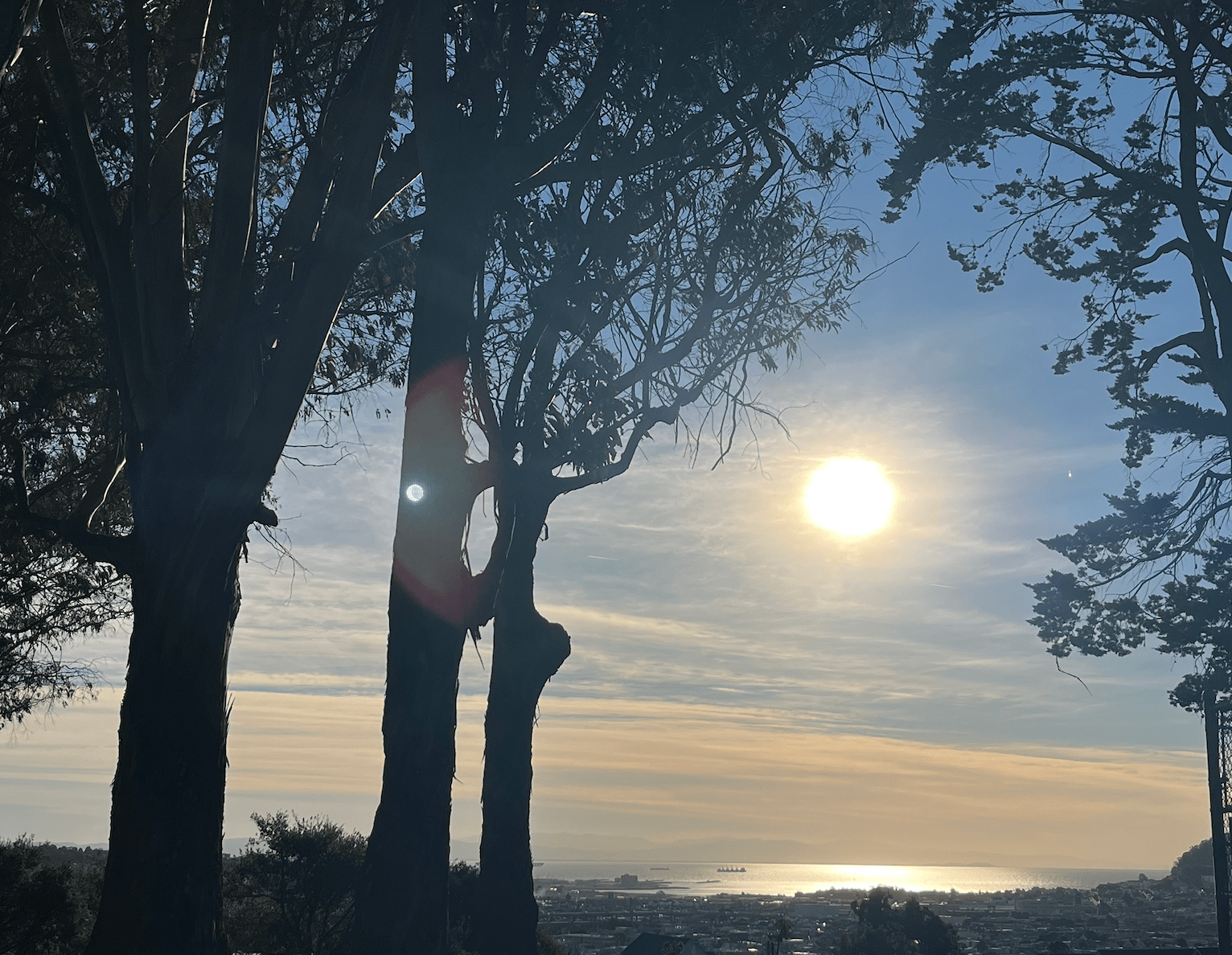
Heading into next week, I am happy to share this below reflection on the notion of gratitude, along with the sunrise image from my morning walk today. I am grateful that next week I will be on vacation with my family, at a nearby beach town that has become one of our favorite get-away spots. We will benefit from the quality time together and the active time outdoors. Blessings on your weeks ahead and Happy Thanksgiving to you and yours!

The Gospel calls us to embrace gratitude as a practice to realize the presence of God’s love in the simplest and most ordinary aspects of our lives, to trust that there is always reason to rejoice and hope despite our sadness and anxieties.

Gratitude rooted in faith transforms cynicism and despair into optimism and hope.

To embrace Christ’s spirit of gratitude opens our ears and hearts to the love of God, making whatever good we do into experiences of grace.

And this grace makes us “whole” and “clean” and filled with Christ’s hope and compassion.

-Deacon Jay Cormier

Courage changes things and courage changes us. It’s how we become. -Prentis Hemphill

This week I share a few resources. Below is a reflection that teaches us to be OK with uncertainty and doubt, and also to remain hopeful and filled with courage. I find myself living with both of these realities in my day to day rollercoaster of life…walking my dog Bingo is helpful! I recently viewed this Mumford & Sons clip on YouTube and found it uplifting, and I hope you do too…wait for the sheer joy embodied by the smile on Jon Batiste’s face as he concludes the song with a solo. Blessings on your week ahead!

“For the Gift of Doubt” – Kate Bowler

I long for understanding,

but life is full of unanswered questions. 

Oh God, reveal to me what I need to know now,

  and for the rest . . .

  teach me how to live with so much uncertainty.

Blessed are we who come to you in the discomfort of our doubt,

  for we trust that our honest unknowing is a truer and better prayer

  than bootstrapping efforts at certainty.

Blessed are we, receiving the gift of doubt,

  for we trust that it is a doorway, freeing us to become

  all that we could not otherwise have known.

Blessed are we, remembering that you hold all things together.

You are the invisible scaffolding that supports us,

  the canopy of love that covers us in the present,

  the stable pillars, sunk deep into our past,

  and the sparrow that flies confidently toward the future

     bearing for us the peace we could never have attained for ourselves. 

Blessed are we, settling into the trust that there are things we can’t know,

  settling into the humility that knows this one thing:

  that we are of the earth, while you bear up the universe.

The God of justice is with us, and our word, our work, our prayer for freedom will not, cannot be in vain. -Elizabeth Cady Stanton

I took our dog on a long walk this morning to clear my head. At our favorite neighborhood park our little puppy was startled multiple times by the strong wind. I was reminded of the Bible passage from the book of Kings, where Elijah sought God in the earthquake, the fire, and the gust of wind…but it was in the gentle whisper that God was recognized. I pray for these gentle whispers of God’s presence grounding me in the days ahead.

I share this below resource on prayer as a suggestion for our focus on action and reflection. Plus a classic cover song from the Boss. God’s blessings on your week ahead!

Reflecting on Prayer                                                      Peter Oliver

Jesus spent a lot of time talking to his followers about prayer.  He encouraged them to pray.  He taught them how to pray.  He told them parables about prayer.  Praying is probably the most important thing a follower of the Gospel needs to do.  The first and most important command is that we love God (Matthew 22:35-38), and we do that in prayer. Followed by action.  


Hurry is the great enemy of spiritual life in our day. We must eliminate hurry in our lives. -John Mark Comer

October has been a blur of a month and I find myself working to ground my pace in ongoing spaces for reflection and prayer. I am definitely a work in progress. The other day I walked our dog by the San Francisco Bay around a new waterfront park nearby, and I recognized how blessed I am by the investment that San Francisco makes in its public parks. Taking the time to realize blessings like this is a gift.

Today I share some resources on the benefits of prayer. Blessings on your week ahead!

From Ronald Rolheiser

Our adult years are a marathon, not a sprint, and so it is difficult to sustain graciousness, generosity, and patience through the tiredness, trials, and temptations that beset us through those years. All on our own, relying on willpower alone, we too often fatigue, get worn down, and compromise both our maturity and our discipleship.

We need help from beyond, from somewhere even beyond the human supports that help bolster us. We need God’s help, strength from something beyond what is human. We need prayer.

The Difference- Grace L. Naessens

I got up early one morning and rushed right into the day;

I had so much to accomplish, I didn’t have time to pray.

Problems just tumbled about me and grew heavier with each task;

Why doesn’t God help me, I wondered; He answered, “You didn’t ask.”

I wanted to see joy and beauty, but the day toiled on, gray and bleak;

I wondered why God didn’t show me – He said, “But you didn’t seek.”

I tried to come into God’s presence; I used all my keys at the lock;

God gently and lovingly chided, “My child, you didn’t knock.”

I woke up early this morning and paused before entering the day;

I had so much to accomplish that I had to take time to pray.

One love, one life, throw your hands up high ’cause all I am trying to do is stay human with you. -Michael Franti

I have a few things going on for work that are stretching me a bit in terms of new experiences, and some difficult decisions on the horizon. I strive to take the long view and I have learned that perspective really matters. I am reading Ronald Rolheiser’s Sacred Fire and I find it to be a grounding resource. This week I share some selections on the notion of justice and charity, along with a video link from artist Michael Franti. Blessings on your week ahead!

From Sacred Fire: A Vision for A Deeper Human and Christian Maturity Ronald Rolheiser

Charity, as we know, can sometimes operate independently of justice, especially of social justice. Jesus does not ask us to give in charity to the poor, he also asks us to work at correcting all the social, political, and economic structures that disadvantage the poor and help keep the poor. Charity seeks to give directly to the poor so as to help alleviate their poverty, Justice seeks to correct the structures that help create that poverty. And Jesus asks us to do both.

From Mother Teresa of Calcutta’s 1979 address to the De La Salle Brothers

You are the ones that as teachers can stand before the young as the presence of Christ. May the young people entrusted to you always be able to see Christ in you and be filled with his purity and goodness and justice. You are the people who have to lead them. Be the light to them. Be the light that will lead them to God. People, especially the young people, are hungry, hungry for God. You are there to satisfy that hunger.

From The Irresistible Revolution: Living as an Ordinary Radical, Shane Claiborne

And that’s when things get messy. When people begin moving beyond charity and toward justice and solidarity with the poor and oppressed, as Jesus did, they get in trouble. Once we are actually friends with the folks in struggle, we start to ask why people are poor, which is never as popular as giving to charity. One of my friends has a shirt marked with the words of late Catholic bishop Dom Helder Camara: “When I fed the hungry, they called me a saint. When I asked why people are hungry, they called me a communist.” Charity wins awards and applause but joining the poor gets you killed. People do not get crucified for living out of love that disrupts the social order that calls forth a new world. People are not crucified for helping poor people. People are crucified for joining them.

No, I never saw an angel, but is irrelevant whether I saw one or not. I feel their presence around me. -Paulo Coelho

This morning I learned that today is the day that the Catholic Church celebrates the Feast of the Guardian Angels. Who knew? I love learning. So I share a couple resources related to this idea, and give thanks to all the current, former and future angels in my life who God has sent my way. Throughout their lives, and even from the eternal life that awaits me, I continue to feel their love and am grateful. Blessings on your week ahead!

God shows God’s love for us by taking care of us as we make our way here below.  In addition to all that we receive through the ministry of the Church, we enjoy the help of the saints, those holy people who have preceded us, in heaven.  Still more, God also gives each person one of God’s holy angels to be a spiritual companion and guide.  This angel is charged by God to keep us safe from harm and give us help and encouragement…  We call upon our guardian angels with devotion and gratitude so that one day we may look upon the face of God in heaven with them. 

-from Magnificat magazine, October 2024

Where do we really stand? The Gospel on this feast of the Guardian Angels sets the bar for true greatness. Accept the vulnerability of [dependence upon] God, as a child depends on its parents, and embrace the obligation to take care of one another, especially children.

-from Peter Dwyer, Give Us This Day, October 2, 2024

God has made everything beautiful for its own time. -Ecclesiastes 3:11

I mark the recent transition to autumn with this poem that Brigid shared with our family last week. We’re in the midst of a flurry of activity, at work and on the home front, so I am grateful for the good weather and the beauty of autumn that awaits. Blessings on your week ahead!

Autumn – by Paul Laurence Dunbar

Don’t talk to me of solemn days
In autumn’s time of splendor,
Because the sun shows fewer rays,
And these grow slant and slender.
Why, it’s the climax of the year,—
The highest time of living!—
Till naturally its bursting cheer
Just melts into thanksgiving.

The very least you can do in your life is figure out what you hope for. And the most you can do is live inside that hope. -Barbara Kingsolver

Over the weekend, I walked our dog on Saturday morning in Golden Gate Park, one of my favorite locations in San Francisco. That I was able to do so after dropping my son off for Cross Country practice brought me such joy. The next day, after dropping my other son off at baseball practice, I enjoyed my morning walk alongside the ocean. I love where I live and hope for each of us that we find joy where we are.

I am happy to share a reflection from a great spiritual writer, Henri Nouwen. Along with this artwork that found its way into my inbox this week, these resources remind us of God’s invitation to serve our neighbor. May we do so with hope and zeal! Blessings on your week ahead.

Henri Nouwen, With Open Hands

When you pray, you discover not only yourself and God, but also your neighbor. For in prayer, you profess not only that people are people and God is God, but also that your neighbor is your sister or brother living alongside you. For the same conversion that brings you to the painful acknowledgment of your wounded human nature also brings you to the joyful recognition that you are not alone, but that being human means being together.

Compassion is daring to acknowledge our mutual destiny so that we might move forward, all together, into the land which God is showing us.